What is AEO? The Future of Search in the Age of AI
Learn what Answer Engine Optimization (AEO) is, how it differs from traditional SEO, and how to optimize your content for AI-powered search engines like ChatGPT, Gemini, and Google AI Overviews.
Introduction
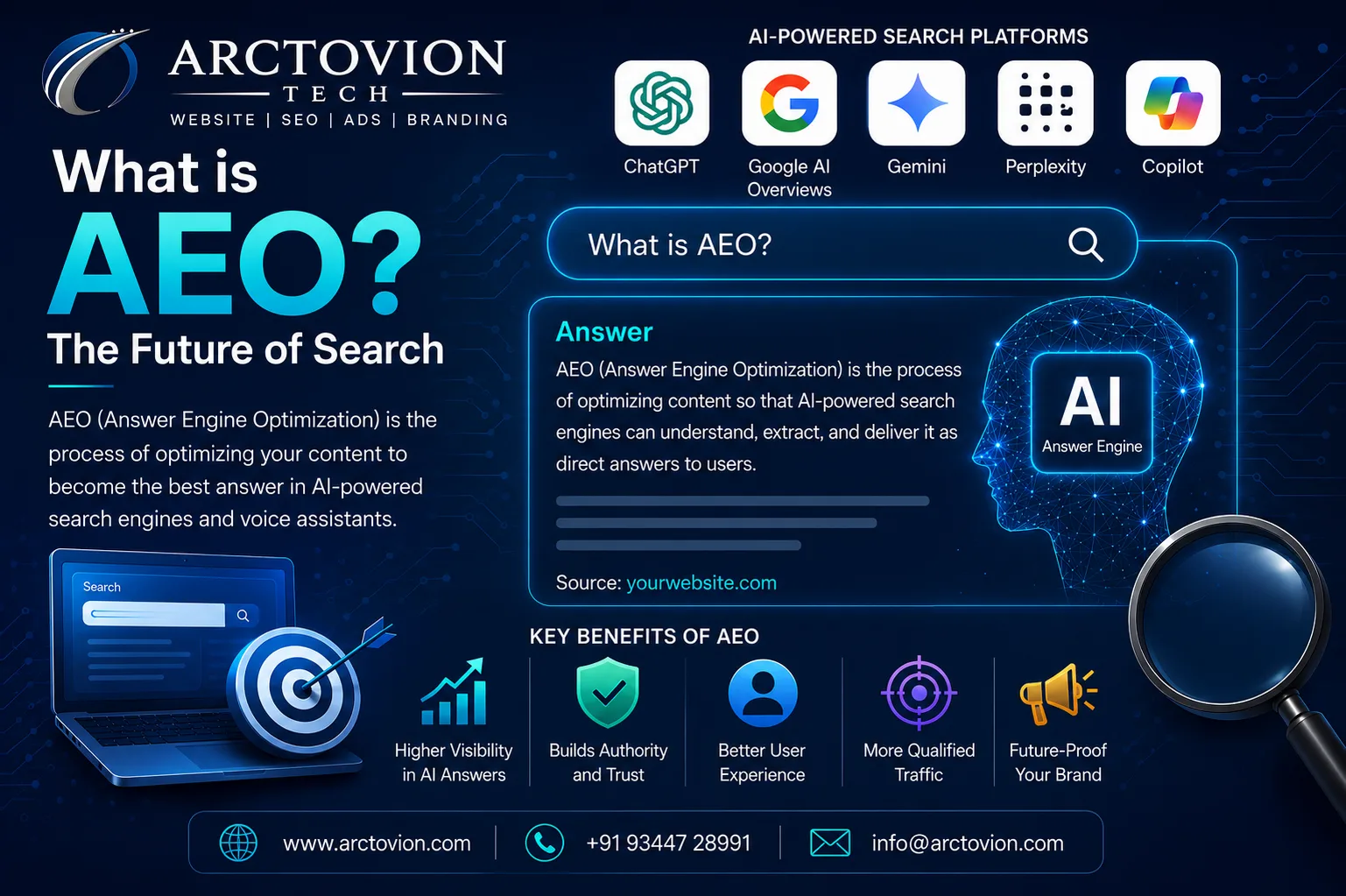
Search is changing. People are no longer using search engines only to find a list of websites. They are increasingly asking complete questions and expecting direct, conversational answers from AI-powered search experiences.
Platforms such as ChatGPT, Google AI Overviews, Gemini, and Perplexity are changing how people discover information, compare businesses, research products, and make decisions.
This has created growing interest in AEO — Answer Engine Optimization.
AEO focuses on creating content that is clear, useful, structured, trustworthy, and easy for answer engines and AI systems to understand and use when responding to user questions.
AEO does not replace SEO. Instead, it works alongside SEO to help businesses improve their visibility across traditional search and AI-powered search experiences.
What Is AEO?
AEO (Answer Engine Optimization) is the process of optimizing content so that answer engines and AI-powered search systems can understand the information and potentially use it when generating answers to user questions.
Traditional SEO often focuses on helping a webpage rank prominently in search results.
AEO focuses more heavily on providing a clear answer to a specific question or intent.
For example, a user might search:
What is AEO?
A well-structured page could provide a concise definition near the beginning:
AEO is the practice of creating and structuring content so that AI-powered search and answer systems can better understand and potentially use it when responding to user questions.
The goal is to make your content easy to understand, useful to readers, and accessible to search and AI systems.
AEO vs SEO: What Is the Difference?
AEO and SEO are closely related, but they emphasize different aspects of search visibility.
| SEO | AEO |
|---|---|
| Focuses on search visibility and rankings | Focuses on being useful for direct answers |
| Targets traditional search results | Targets AI-powered and answer-based search experiences |
| Often focuses on keywords and search intent | Strongly focuses on questions and conversational intent |
| Optimizes webpages for search engines | Structures information so answer systems can understand it |
| Measures rankings, clicks and organic traffic | Can also consider visibility in AI-generated answers |
However, these strategies should not be treated as completely separate.
Strong technical SEO, useful content, clear structure, authority, and good user experience can support both SEO and AEO.
Why Is AEO Important?
The way people search is becoming more conversational.
Instead of searching only:
- AEO
- SEO tools
- Digital marketing
Users may ask:
- What is AEO?
- How does AEO work?
- What is the difference between SEO and AEO?
- How can a business optimize its website for AI search?
- Which SEO strategies can improve AI search visibility?
This means businesses need content that addresses real questions and user intent, rather than simply repeating keywords.
Benefits of AEO
A strong AEO-focused content strategy can help businesses:
- Provide clearer answers to customers
- Improve content accessibility and understanding
- Strengthen topical authority
- Support visibility across evolving search experiences
- Improve conversational search experiences
- Attract users who are researching specific questions
- Build trust through accurate and useful information
AEO should therefore be viewed as part of a broader search visibility strategy, rather than a replacement for traditional SEO.
How Does AEO Work?
Answer engines and AI-powered search systems use sophisticated technologies to understand information and generate responses.
The exact process differs between platforms, but a simplified model looks like this:
User asks a question
        ↓
AI understands the query
        ↓
Relevant information is identified
        ↓
Sources/content are evaluated
        ↓
Useful information is selected
        ↓
AI generates a response
For businesses, this means content should be:
- Clear
- Relevant
- Well structured
- Accurate
- Easy to understand
- Supported by credible information
- Focused on the user's actual question
There is no guaranteed formula that makes a website appear in every AI-generated answer. Different AI systems use different technologies and sources.
7 Important AEO Strategies
1. Answer Questions Directly
One of the simplest AEO practices is to answer important questions clearly.
For example:
What is digital marketing?
Digital marketing is the promotion of products and services through digital channels such as search engines, websites, social media, email, and online advertising.
Then expand with supporting information.
Avoid forcing users to read five paragraphs before reaching the answer.
A useful structure is:
Question
↓
Short direct answer
↓
Detailed explanation
↓
Example
↓
Related questions
2. Understand Search Intent
Before creating content, understand why the user is searching.
For example:
Query:
"How much does SEO cost?"
The user probably wants pricing information.
Query:
"What is technical SEO?"
The user wants an explanation.
Query:
"Best SEO agency in Chennai"
The user is probably researching providers.
Your content should match the intent behind the query.
3. Use Question-Based Content
Create sections around questions your audience actually asks.
For example:
What is AEO?
How does AEO work?
Why is AEO important?
AEO vs SEO: What is the difference?
How can businesses implement AEO?
What are the benefits of AEO?
What are common AEO mistakes?
This creates a clear structure for both users and search systems.
4. Create Helpful, Comprehensive Content
AEO doesn't mean writing extremely short answers.
A strong page should answer the main question and provide enough context to help the reader.
Depending on the topic, include:
- Definitions
- Examples
- Step-by-step explanations
- Comparisons
- Statistics from reliable sources
- FAQs
- Practical recommendations
- Related questions
For example, an article about SEO for restaurants could cover:
What is restaurant SEO?
        ↓
Why restaurant SEO matters
        ↓
Google Business Profile
        ↓
Local keywords
        ↓
Restaurant website optimization
        ↓
Reviews
        ↓
Local content
        ↓
FAQs
This builds a complete resource around the user's topic.
5. Use Clear Content Structure
Make your content easy to scan.
Use:
- One clear H1
- Descriptive H2 headings
- H3 subheadings where necessary
- Short paragraphs
- Bullet points
- Tables
- Examples
- Relevant internal links
For example:
H1: What Is AEO?

H2: What Is Answer Engine Optimization?

H2: Why Is AEO Important?

H2: AEO vs SEO

H2: How Does AEO Work?

H2: AEO Strategies

H3: Answer Questions Clearly

H3: Understand Search Intent

H3: Create Helpful Content

H2: Frequently Asked Questions
Good structure helps users find information quickly.
6. Use Structured Data Where Appropriate
Structured data, commonly implemented using Schema.org vocabulary, provides machine-readable information about a webpage.
Depending on the page, relevant structured data may include:
- Article
- Organization
- LocalBusiness
- Product
- BreadcrumbList
- Event
- FAQPage, where appropriate
Structured data can help search engines understand the page's content and entities.
However, adding schema does not guarantee an AI system will use your content or that Google will display a rich result.
The structured data should accurately represent the visible content on the page.
7. Build Trust and Authority
AI systems need useful information, and users need information they can trust.
Improve content quality by:
- Using accurate information
- Citing reliable sources when appropriate
- Demonstrating relevant expertise
- Keeping important information updated
- Providing author information where useful
- Avoiding misleading claims
- Correcting outdated information
For business websites, also make it easy to understand:
- Who the company is
- What services it provides
- Where it operates
- How to contact it
- What experience it has
AEO Content Example
Suppose you operate a digital marketing company.
Instead of creating a page containing only:
AEO Services
Create useful content such as:
What is AEO?
AEO is the practice of creating and structuring content so that AI-powered search and answer systems can better understand and potentially use that information when responding to user questions.
Why does AEO matter?
Users increasingly use conversational searches and AI-powered tools to research products, services, and information. Creating clear, useful content can help businesses adapt to these changing search behaviors.
How can a business improve its AEO?
A business can start by:
- Identifying common customer questions.
- Creating accurate answers.
- Organizing content with descriptive headings.
- Using relevant structured data.
- Demonstrating expertise and trust.
- Maintaining technically sound SEO.
- Updating important content regularly.
This is much more useful than repeatedly inserting the keyword "AEO" throughout the page.
AEO for Different Types of Businesses
Local Businesses
A local business can create content answering questions such as:
- What services does the business provide?
- Where is the business located?
- What areas does it serve?
- How much does the service cost?
- How can customers contact the business?
For example, a taxi company might create useful pages around:
"How much does a Chennai to Madurai taxi cost?"
The page should provide genuinely useful information rather than simply repeating the phrase.
E-commerce Businesses
E-commerce websites can create:
- Product guides
- Comparison pages
- Buying guides
- Product FAQs
- Usage instructions
- Product specifications
Example:
Which running shoes are best for beginners?
A helpful article could explain the factors a buyer should consider before recommending products.
SaaS Companies
Software companies can create:
- Product documentation
- Tutorials
- How-to guides
- Troubleshooting pages
- Comparison articles
- Industry guides
- FAQs
For example:
How does CRM software help small businesses?
A detailed, practical answer can attract users who are researching a solution.
AEO and Voice Search
AEO is also closely associated with conversational search.
Voice searches often look more like natural questions:
"What is the best digital marketing agency near me?"
or:
"How do I improve my website SEO?"
This makes question-based content and natural language particularly useful.
However, voice search and AEO should not be treated as identical concepts. They overlap because both can involve conversational queries, but they are broader than simply optimizing for voice assistants.
Common AEO Mistakes
❌ Keyword stuffing
Repeating:
AEO AEO AEO AEO
doesn't make content better.
❌ Writing only for AI
Your primary audience is still people.
Content should be useful and readable for humans.
❌ Creating hundreds of low-quality pages
Automatically generating large numbers of pages with little unique value can create quality and indexing problems.
❌ Making unsupported claims
Don't claim:
"Add FAQ schema and ChatGPT will rank your website."
There is no guaranteed technique like this.
❌ Ignoring technical SEO
AEO doesn't mean you can ignore:
- Crawling
- Indexing
- Canonicals
- Sitemap
- Mobile usability
- Page performance
- Internal linking
- HTTPS
A technically poor website can undermine your overall search visibility.
AEO + SEO Strategy
The best approach isn't:
SEO OR AEO
It is:
SEO + Helpful Content + AEO
                SEARCH VISIBILITY
                       │
          ┌────────────┴────────────┐
          ▼                         ▼
      Traditional SEO             AEO
          │                         │
     Technical SEO           Direct Answers
     On-Page SEO             Questions
     Internal Links           Conversational Content
     Backlinks                Clear Structure
          │                         │
          └────────────┬────────────┘
                       ▼
                 Useful Content
                       │
                       ▼
                Better Visibility
How to Start AEO for Your Website
You don't need to completely rebuild your website.
Start with these steps:
Step 1 — Find customer questions
Use:
- Google Search Console
- Google search suggestions
- "People also ask"
- Customer support questions
- Sales team questions
- Keyword research tools
Step 2 — Create useful answers
Create pages or sections that answer those questions directly.
Step 3 — Improve content structure
Use:
- H1
- H2
- H3
- Lists
- Tables
- Short paragraphs
- FAQs
Step 4 — Improve technical SEO
Check:
- Crawling
- Indexing
- Sitemap
- Robots.txt
- Canonical tags
- Mobile usability
- Page speed
- Internal links
Step 5 — Add appropriate structured data
Use only schema that accurately describes the page.
Step 6 — Build authority
Publish genuinely useful content and earn relevant mentions and links.
Step 7 — Monitor results
Track:
- Organic clicks
- Impressions
- Rankings
- Indexed pages
- Referral traffic
- Brand searches
- AI/search visibility where measurable
Frequently Asked Questions
What does AEO stand for?
AEO stands for Answer Engine Optimization.
Is AEO replacing SEO?
No. AEO complements SEO. Businesses should continue investing in technical SEO, useful content, search intent, authority, and user experience.
Does AEO guarantee that ChatGPT will mention my website?
No. There is no guaranteed method for making an AI platform mention a particular website.
Is AEO only for AI websites?
No. AEO principles can be useful for websites that want their information to be understandable and useful across modern search and answer experiences.
Does schema guarantee AI visibility?
No. Structured data helps machines understand content, but it does not guarantee rankings, AI citations, or inclusion in generated answers.
How long should an AEO article be?
There is no fixed word or character limit. Write enough to completely satisfy the user's search intent. For a detailed informational topic, 1,500–2,500 words can be a practical starting range, but quality and completeness matter more than hitting a number.
Conclusion
Answer Engine Optimization is an emerging approach to improving how content is understood and surfaced in AI-powered and answer-based search experiences.
The foundation of effective AEO is not keyword stuffing or trying to manipulate AI systems. It is creating accurate, useful, well-structured content that clearly answers real user questions.
Businesses should combine AEO with strong technical SEO, helpful content, structured data where appropriate, and genuine authority.
The future of search will continue to evolve. Businesses that focus on being useful, trustworthy, and easy to understand will be better prepared for that change.
Simple formula:
Understand the question → Give the best answer → Structure it clearly → Build trust → Keep it updated → Support it with strong SEO.
Need help growing online?
Talk to Arctovion Tech about websites, SEO, ads, or custom software for your business.
Book a free consultationFrequently asked questions
What is Answer Engine Optimization (AEO)?
How is AEO different from traditional SEO?
Why is AEO important for businesses?
Which platforms use AEO principles?
Can AEO replace SEO?
How can I optimize my content for AEO?
What role does AI play in AEO?
What are the benefits of AEO for website owners?
How does AEO support voice search?
What is the future of AEO?
 Digital Marketing
Google Ads for Business: Complete Guide
Discover how Google Ads can help businesses reach potential customers, generate qualified leads, increase sales, and build a measurable digital marketing strategy.
 SEO
SEO
What is SEO
Learn what SEO is, how it works, its key types, and the best practices businesses can use to improve search visibility, attract organic traffic, and generate more leads.
 ABOUT
ABOUT
Why We Founded Arctovion Tech
Discover why Arctovion Tech was founded as a custom software development company in Chennai to help businesses build tailored software, web applications, mobile apps, and digital solutions that simplify operations and support long-term growth.
Comments
Join the discussion — comments are moderated before they appear.
Loading…