Integration experience
We have connected payments, SMS, WhatsApp, CRM, ERP and logistics APIs for growing Indian businesses.
Spreadsheets and copy-paste stop scaling the moment your CRM, payments, logistics and analytics need to talk. Arctovion Tech delivers REST API Integration, Custom API Development and Enterprise API Integration so data moves securely, on schedule, and without fragile one-off scripts.
Trusted by product and ops teams who need systems that stay in sync — not integrations that break after every vendor update.

An API call is easy. A reliable integration is not. We design connectors with auth, rate limits, retries and observability — so your CRM, payments and warehouse stay aligned when traffic spikes or a vendor changes a field.
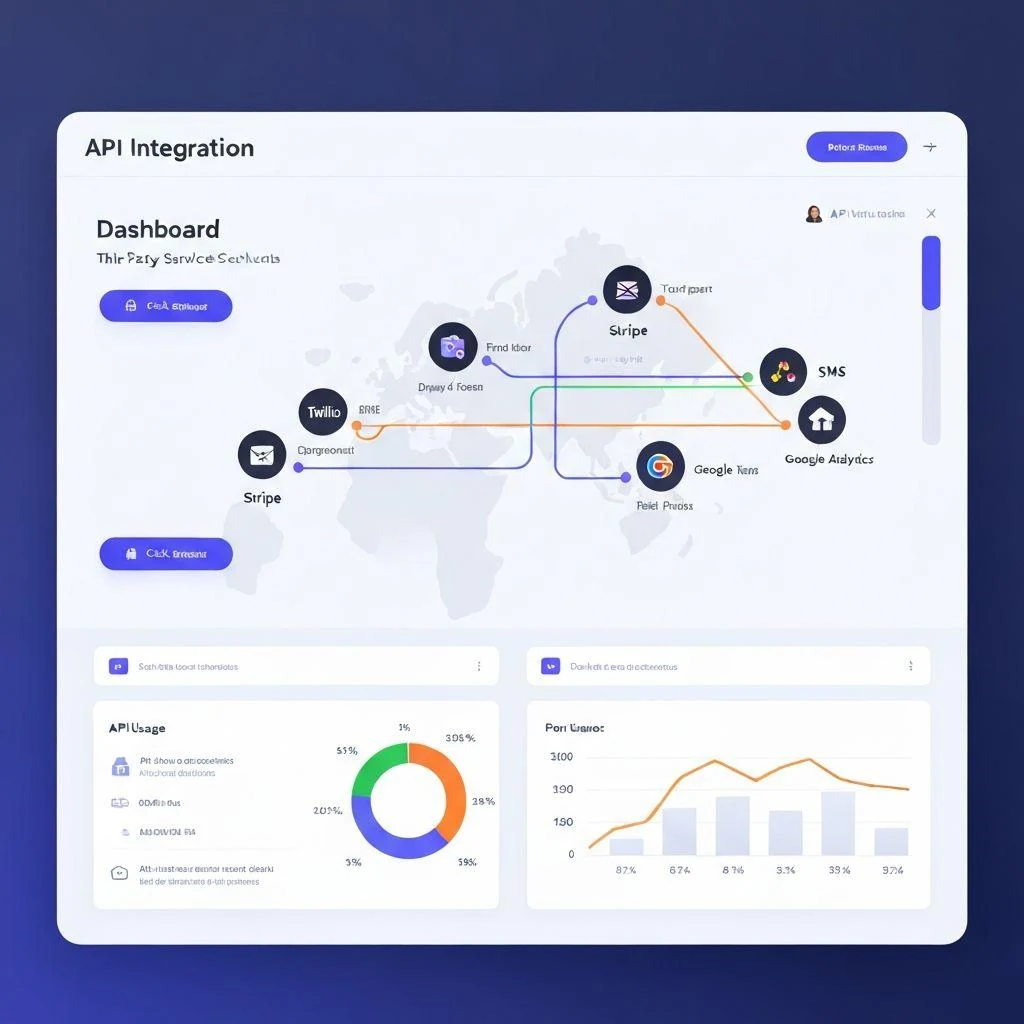
We have connected payments, SMS, WhatsApp, CRM, ERP and logistics APIs for growing Indian businesses.
A standard REST connector with webhooks usually ships in one to two weeks.
Fixed proposals per system pair — no open-ended “hours” surprises.
A named engineer for go-live, vendor changes and incident response.
Queues, idempotency keys and structured logging built in from day one.
Middleware that grows from one connector to a full enterprise mesh.
OAuth, API keys, least privilege and encrypted secrets — never hard-coded.
When vendors fall short, we build the API your product actually needs.
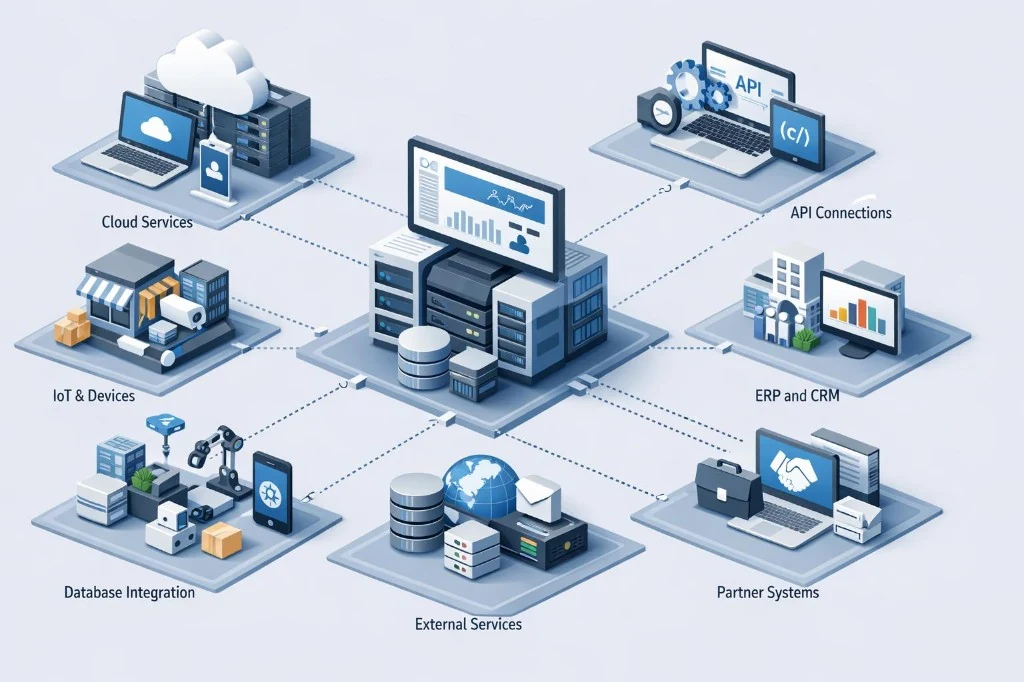
Third-Party API Integration connects your software to external services — payment gateways, CRMs, ERPs, shipping partners, analytics and messaging — so data and actions flow automatically instead of through manual exports.
Businesses need it the moment tools multiply. Without proper REST API Integration, teams re-key data, reports disagree, and customers see stale order status. Good integrations remove that friction.
Who should use it: startups wiring SaaS tools, mid-market teams syncing CRM and ERP, enterprises connecting partner systems, and product companies exposing Custom API Development for clients and mobile apps.
Where it is headed: event-driven architectures, GraphQL and webhooks as defaults, stronger OAuth scopes, and AI agents that call APIs safely. Solid middleware absorbs those shifts without a rewrite.
For standards we build against daily, the OpenAPI Specification remains the clearest contract format between systems.

Eight clear stages — each with a business benefit you can track.
Systems, data fields, volumes and failure rules documented.
Benefit: right scope before any codeAuth model, mapping, rate limits and rollout order agreed.
Benefit: predictable timeline and riskOpenAPI specs, event schemas and error codes designed.
Benefit: clear contracts for every teamConnectors, middleware, webhooks and queues built.
Benefit: reliable data movementSandbox calls, retries, partial failures and load checks.
Benefit: fewer production surprisesSecrets, monitoring and staged cutover to live traffic.
Benefit: safe, reversible go-liveRunbooks, dashboards and ownership handed to your team.
Benefit: ops stays independentVendor API changes, version upgrades and alerts on retainer.
Benefit: integrations keep workingFifteen capabilities teams ask for most — each tied to a business outcome.
Secure REST connectors with auth, mapping and validation.
Systems stay in syncBuild the API your product or partners need.
Own your data contractCRM, ERP, WMS and partner hubs connected at scale.
One source of truthPush updates the moment something changes.
Near real-time workflowsToken refresh, scopes and rotated secrets.
Safer access controlQueues and back-off when vendors throttle.
No silent data lossSafe replay without duplicate records.
Cleaner books and CRMMap fields, formats and currencies between systems.
Fewer manual fixesA central hub instead of spaghetti point-to-point links.
Easier to extend laterFlexible queries for mobile and dashboard clients.
Less over-fetchingSFTP, CSV and scheduled bulk jobs.
Legacy systems coveredLatency, error rate and dead-letter queues watched.
Issues caught earlySafe test environments before production cutover.
Lower launch riskOpenAPI specs and runbooks your team can use.
Faster onboardingSame backend powering apps, portals and partners.
One integration, every channelROI shows up as fewer manual hours, cleaner data and faster product releases.
Automation — orders, leads and inventory move without re-keying.
Accuracy — one mapped contract beats conflicting spreadsheets.
Speed to market — ship features that rely on vendor APIs faster.
Customer trust — live status and confirmations stay up to date.
Lower support load — fewer “data mismatch” tickets.
Scalability — add partners without rewriting core code.
Security — secrets and scopes managed properly.
Observability — know when a vendor or job fails.
Vendor flexibility — switch providers with less pain.
Future growth — middleware ready for the next SaaS tool.
Compliance readiness — auditable logs of what moved where.
Defendable investment — you own the code and documentation.
Same integration discipline — connectors tuned to how each sector moves data.
Tools chosen for reliability, clear contracts and safe operations — not trend chasing.
React admin views for mapping status, retries and health.
Node.js, Laravel or Spring Boot for connectors and middleware.
Android, iOS and Flutter clients calling your custom APIs.
AWS or Firebase for queues, webhooks and elastic load.
PostgreSQL / MySQL with sync state and audit history.
Secrets vaults, staging gates and monitored deploys.
OAuth2, mTLS where needed, and least-privilege keys.
Error rates, latency and throughput dashboards.
Payments, SMS, WhatsApp, CRM, ERP, logistics and analytics APIs.
A straight look at support, reliability and what happens after launch.
| Criteria | Arctovion Tech | Typical agency | Freelancer |
|---|---|---|---|
| Support | Named owner for go-live & incidents | Ticket queues after handover | Depends on availability |
| Security | OAuth, secrets vault, least privilege | Varies by project lead | Often hard-coded keys |
| SEO / UX | Clear ops dashboards when needed | Sometimes extra cost | Rarely considered |
| Performance | Queues, retries, latency tracked | Checked late | Not measured |
| Communication | Written mapping & test plan | Status decks | Chat-only |
| Documentation | OpenAPI + runbooks | Partial | Minimal |
| Warranty | Defect window on go-live | Short or unclear | Usually none |
| Maintenance | Vendor API changes planned | New SOW each time | Ad-hoc |
Straight answers for product and ops teams planning REST and enterprise integrations.
They connect your software to external systems — CRM, ERP, payments, messaging, logistics and analytics — so data and actions move automatically. The work includes auth, mapping, webhooks, retries, monitoring and documentation.
REST API Integration uses HTTP endpoints to create, read, update and delete data between systems. We add proper authentication, validation, rate-limit handling and error recovery so those calls stay reliable in production.
When a vendor API is incomplete, too slow, or your partners need a cleaner contract. We design and build APIs that fit your product — with OpenAPI docs, versioning and auth — instead of forcing awkward workarounds.
It connects larger stacks — CRM, ERP, WMS, finance and partner portals — with stronger governance: environments, audit logs, SLAs and change control. Middleware keeps those links maintainable as the company grows.
A standard single-system REST connector takes about one to two weeks. Multi-system enterprise work, custom APIs or complex transformations take longer. We confirm scope and timeline in writing first.
Payments, SMS, WhatsApp, CRM, ERP, ecommerce, logistics, accounting, analytics and most SaaS tools with a documented API. If there is only a file feed or webhook, we can still design a solid path.
Queues, retries with back-off, idempotency keys, dead-letter handling and alerts. Critical jobs do not silently drop when a vendor is briefly down.
Yes. We use HTTPS, OAuth or scoped keys, encrypted secrets storage and least-privilege access. Credentials are never committed to source control.
Yes. We set up health checks, error-rate alerts and optional retainers so vendor API changes or broken jobs are caught before customers notice.
Yes. We inventory existing scripts, replace them with tested connectors, and cut over with dual-running where needed so operations keep moving.
Yes. Event-driven designs push updates the moment something changes, with signature verification so only trusted events are processed.
Cost depends on systems, data volume and custom work. After a short discovery call we send a fixed proposal with milestones and out-of-scope items.
You do, for paid and delivered milestones — repositories, OpenAPI specs and runbooks included.
Yes. Retainers cover vendor version upgrades, new endpoints, monitoring and incident response so integrations stay healthy as APIs evolve.
Share the systems you need connected, sample payloads if you have them, and your goals via the contact form or a call. We return with a discovery agenda and a written plan.
A realistic composite based on patterns we see across ops-heavy clients — not a fabricated brand claim.
A growing retailer kept CRM, ecommerce and warehouse data in separate tools. Orders were exported by hand, stock levels lagged, and support kept apologising for wrong ETAs.
Enterprise API Integration with a small middleware layer: ecommerce webhooks into the warehouse, stock sync back to the storefront, and CRM updates when shipments moved.
Manual exports stopped once webhooks became the source of truth. Stock and shipping status stayed current, and the team later added a courier API on the same middleware without rewriting the core flow.
Tell us which tools need to talk and what should happen when they fail. Arctovion Tech will reply with a clear integration plan — scope, security and milestones — so your stack stays in sync.